
Account Receipt Setting
View and manage account receipt types, money collections, and journal voucher categories.
Account Receipt Setting
Account Receipt Setting enables developers to view, search, and manage financial receipt vouchers, customer collection entries, double-entry journal vouchers, fund transfers, and party debit or credit notes.
Account receipt types control how incoming payments, ledger transfers, and adjustments are categorized and posted across the general ledger and counterparty balances.
When you use this
- Reviewing all configured customer collections, transfers, and adjustment voucher classifications.
- Searching for specific receipt types by name or technical serial number.
- Exporting receipt voucher configurations to Excel or CSV for financial audits.
- Opening the editor to configure new or existing receipt classifications.
Before you start
- Sign in to the Developer Console with your developer credentials and two-factor code.
- Ensure Chart of Accounts sections and financial ledgers exist in the Account module.
- Verify receipt print layouts and acknowledgement slips in Invoice Templates.
Open the receipt settings screen
In the Developer Console left navigation explorer, under the General section, click Account Receipt Setting.
Search or filter receipt types
Use the live Search bar above the datatable to find receipt types by name or identifier. Adjust visible records with the Show dropdown.
Manage columns or export
Click Columns to toggle visible table columns, or click Export to download the records as Excel or CSV.
Open the creation window
Click Add Account Receipt Setting in the top right corner above the datatable to open Account Receipt Setting Edit.
Every field on this screen
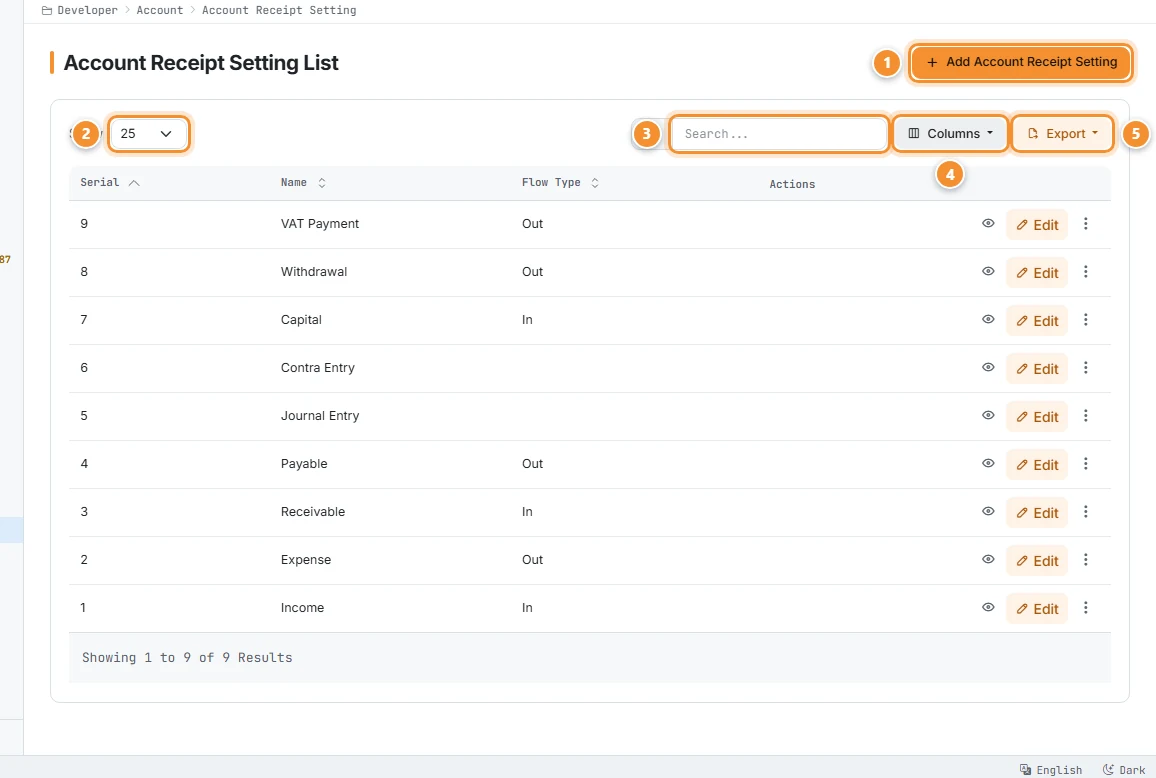 The account receipt type list and settings screen
- Add Account Receipt Setting — opens the modal window to create a new money receipt or ledger entry type.
- Show — controls how many receipt type records to display per table page (10, 25, 50, 100, or 250).
- Search — real-time filter searching receipt types by name or serial number.
- Columns — dropdown menu toggling visibility of table columns (Serial, Name, Form Type, Prefix, Suffix, Status, and Actions).
- Export — exports the visible receipt types table to Excel or CSV format.
In the table, each row displays Serial, Name, Form Type, Flow Type, Prefix, Suffix, Status, and action buttons to modify or Delete records.
Complete example: Auditing money collection vouchers
Suppose an accounts officer needs to check which vouchers are used for customer cash receipts:
- Navigate to Account Receipt Setting in the Developer Console navigation.
- In the Search input, type
Receipt. - The table displays all matching receipt classifications along with their form types (such as
Single Entry) and active statuses. - Click Export to save the verified configurations to an Excel spreadsheet for the audit committee.
How to extend
- Define custom numbering prefixes for cash collections or bank transfers in Account Receipt Setting Edit.
- Create custom voucher and money receipt print layouts using Order Setting.
- Pair with Payment Setting for full inbound and outbound transaction reconciliation.
Rules and pitfalls
- Deleting an active receipt type prevents accounts staff from selecting it during voucher entry.
- Form type determines double-entry validation logic and cannot be changed once transactions exist.
- Ensure numbering prefixes are unique across all collection and voucher types.
Common questions
What is the difference between Account Receipt Setting and Payment Setting? Account Receipt Setting configures incoming money collections from customers. Payment Setting configures outgoing disbursements and money paid out.
Where do staff record transactions using these receipt types? Staff select configured receipt types when creating collection vouchers or transfers in the Account module.