
Menu Setting
View and manage website menu schemas, navigation locations, and custom link attributes.
Menu Setting
Menu Setting enables developers to view, search, and manage website menu schemas, navigation locations, and custom schema attributes for public website templates.
Menu schemas provide the blueprint for the Member Area menu builder and website themes, dictating what parameters (such as icons, badges, colors, or category links) can be attached to navigation items.
When you use this
- Reviewing all configured website menu locations across your themes.
- Searching for specific menu locations by title or technical identifier.
- Exporting navigation menu schemas to Excel or CSV for documentation.
- Opening the editor to configure new or existing menu schemas.
Before you start
- Sign in to the Developer Console with your developer credentials and two-factor code.
- Ensure website theme templates support the specified menu location names in their theme layouts.
- Familiarize yourself with the visual schema builder data types.
Open the menu settings screen
In the Developer Console left navigation explorer, under the Website section, click Menu Setting.
Search or filter menu schemas
Use the live Search bar above the datatable to find menu schemas by title or identifier. Adjust visible records with the Show dropdown.
Manage columns or export
Click Columns to toggle visible table columns, or click Export to download the records as Excel or CSV.
Open the creation window
Click Add Menu Setting in the top right corner above the datatable to open Menu Setting Edit.
Every field on this screen
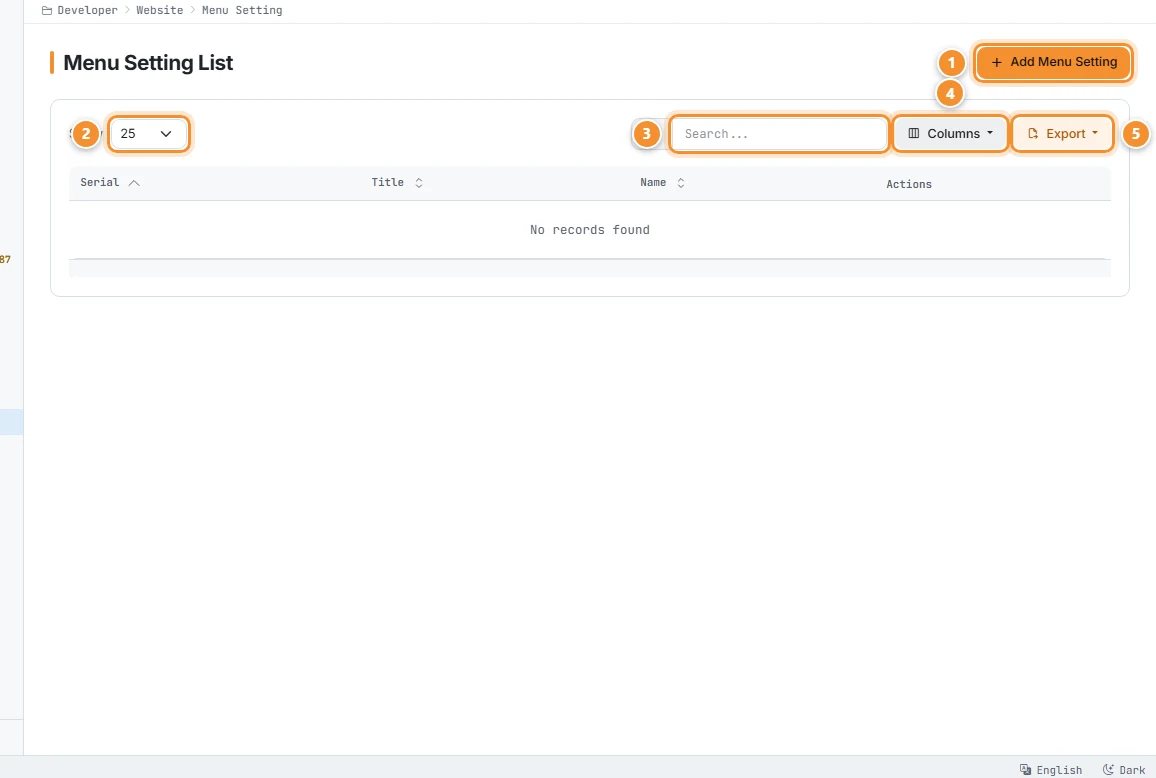 The menu schema list and settings screen
- Add Menu Setting — opens the modal window to create a new website menu schema.
- Show — controls how many menu schema records to display per table page (10, 25, 50, 100, or 250).
- Search — real-time filter searching menu schemas by title or technical identifier.
- Columns — dropdown menu toggling visibility of table columns (Serial, Title, Name, and Actions).
- Export — exports the visible menu schemas table to Excel or CSV format.
In the table, each row displays Serial, Title, Name, and action buttons to modify or Delete records.
Complete example: Auditing active website menu locations
Suppose a web designer needs to verify which navigation menus are available for theme templates:
- Navigate to Menu Setting in the Developer Console navigation.
- In the Search input, type
Header. - The table displays all matching navigation schemas along with their unique technical names (such as
main_menu). - Click Export to save the verified configurations to an Excel spreadsheet for the front-end design team.
How to extend
- Add custom navigation attributes like promotional badges or icon pickers in Menu Setting Edit.
- Access custom menu parameters in website theme templates using their identifiers.
- Pair with Slider Setting to manage all website presentation schemas.
Rules and pitfalls
- Deleting an active menu schema removes the navigation location from the client menu builder.
- Technical names must remain unique across all menu configurations.
- Schema parameter identifiers must use lowercase alphanumeric snake_case strings.
Common questions
Where do website managers build the actual menu links? Website administrators configure links, dropdowns, and items under the Website menu management screen.
Can menu items include custom badge colors or icons? Yes. Adding attributes in Menu Setting Edit exposes those controls when adding menu links.